
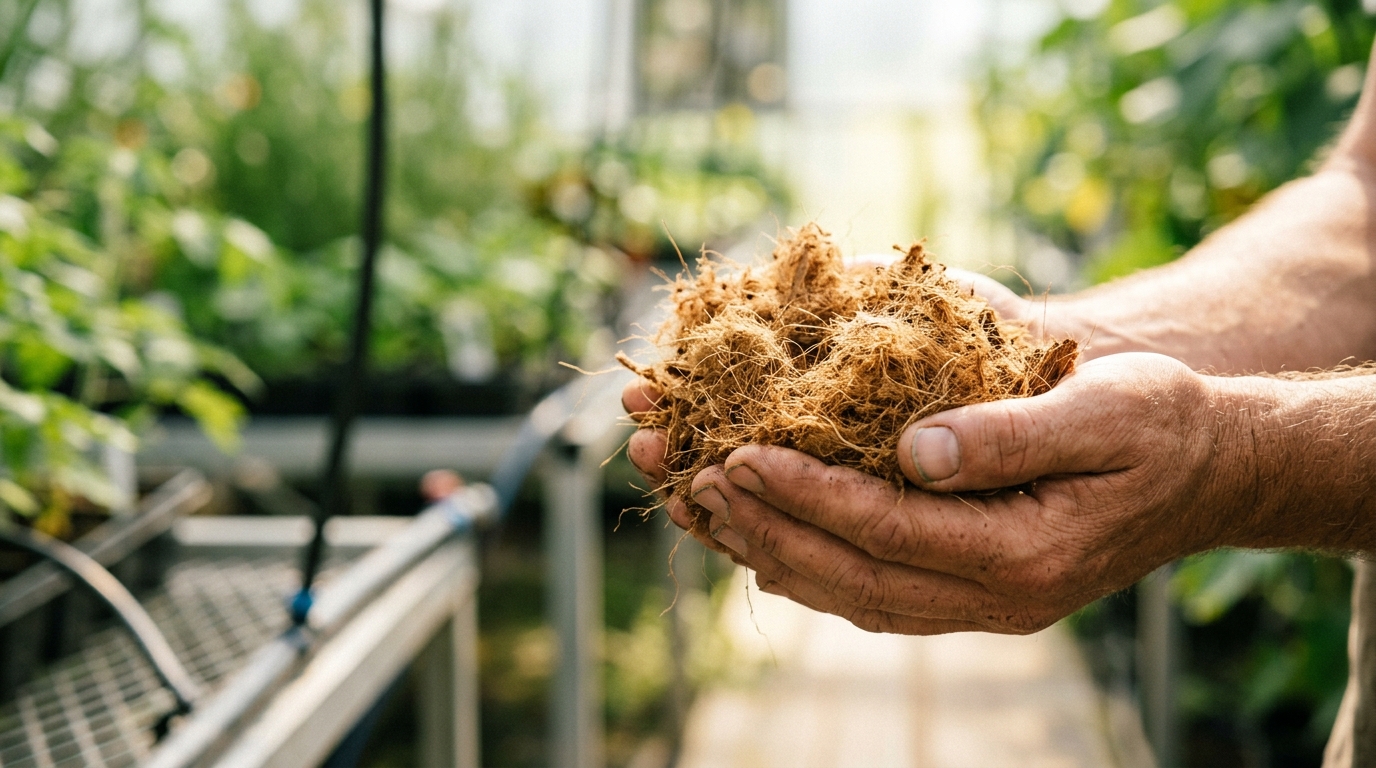
Here is a step-by-step breakdown of how clean coco coir is manufactured.
Raw Material Sourcing & Dehusking
The process begins at coconut plantations and processing mills. Coconuts are harvested, and the fibrous outer shell (husk) is separated from the inner nut. Raw husks are inspected for quality, ensuring they are free from soil contamination, plastic, or foreign debris before entering the processing line.
Decortication & Fiber Extraction
The collected husks are processed through a decorticator machine. This mechanical action breaks open the husks, separating the long, tough fibers from the spongy peat (pith) that surrounds them.
- Coir Fiber: Used for matting, ropes, and structural support.
- Coir Peat / Pith: The primary spongy material used as horticultural growing media.
Natural Aging (Composting)
Raw coir pith contains high amounts of naturally occurring tannins, phenols, and sodium salts. To stabilize the organic material, the coir peat is stored in outdoors heaps to age for 3 to 12 months. Natural aging breaks down volatile organic compounds and stabilizes the carbon-to-nitrogen ratio (C:N), ensuring the substrate does not lock up nitrogen when planted.
Thorough Washing & Desalination
Because coconut palms often grow in coastal regions, raw coir is naturally high in sodium (Na⁺) and chloride (Cl⁻). For clean coir, thorough washing with low-EC (Electrical Conductivity) freshwater is essential.
- The coir is flushed multiple times to leach out excess soluble salts.
- The target is typically reducing the EC level below 0.5 mS/cm (1:1.5 extraction method), making it safe for delicate root systems.
Buffering (Optional, Premium Grade)
In addition to surface salts, coir naturally holds sodium and potassium within its cation exchange sites. If unbuffered, the coir will naturally absorb calcium and magnesium from fertilizer solutions while releasing sodium and potassium to the plants, leading to nutrient deficiencies.
The Buffering Process:
The washed coir is soaked in a calcium nitrate (Ca(NO₃)₂) and magnesium sulphate (MgSO₄) solution. Calcium ions displace the bound sodium and potassium ions, which are then rinsed away, resulting in a pre-conditioned substrate with a balanced Cation Exchange Capacity (CEC).
Sieving & Dust Separation
Once washed and buffered, the coir is dried and passed through mechanical rotary sieves (trommels). This step removes fine dust particles (particles smaller than 1mm) that could cause compaction or reduce drainage in grow bags and pots. Screening allows manufacturers to create customized blend fractions—such as 100% peat, 70:30 coir-to-chip blends, or custom coarse grades.
Sun-Drying & Moisture Control
The clean coir is spread out on clean, concrete drying yards or passed through industrial mechanical dryers. Moisture levels are strictly controlled and reduced down to 15%–20%. Controlled moisture prevents mold growth during transit while keeping the material pliable enough for compression without damaging the fiber structures.
Quality Control Testing
Before packaging, batch samples undergo laboratory testing to verify critical parameters:
- Electrical Conductivity (EC): Ensures low salt content.
- pH Level: Typically balanced between 5.5 and 6.5 for optimal nutrient absorption.
- Expansion Ratio & Water Holding Capacity (WHC): Verifies optimal hydration performance.
- Sieve Analysis: Confirms particle size distribution.
Compression & Packaging
To optimize shipping logistics, clean coir is compressed into various forms using high-pressure hydraulic presses:
- 5 kg Blocks & 650g Briquettes: Easy to transport and rehydrate.
- Grow Slabs & Open-Top Bags: Pre-filled in UV-stabilized polyethylene bags ready for commercial hydroponic drip irrigation.
- 50L / 100L Loose Fill Bags: For immediate pot filling without rehydration steps.
Why “Clean” Matters for Growers
Skipping steps like thorough washing, buffering, or fine-dust screening results in raw, high-EC coir that can cause salt burn, calcium deficiency, and root suffocation. Investing in clean, properly processed coco coir guarantees a uniform, sterile, and high-drainage root zone that gives plants the best possible foundation for maximum yield.